
If you’re missing a tooth or multiple teeth or have been told you need various procedures, you’re probably busy weighing the pros and cons of dentures and dental implants.
In this blog, we’ll look at the following:
- Why choose dental implants over dentures?
- Costs of dentures vs. implants
- Maintenance of dentures vs. implants
- What lasts longer dentures or implants?
- Which is less painful, dentures or implants?
- Are permanent dentures cheaper than implants?
Why Choose Dental Implants Over Dentures?
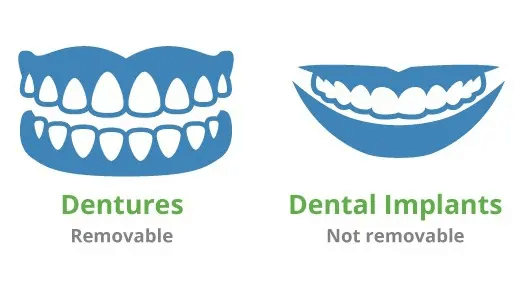
Dentures, also known as false teeth, are fitted to a mouthpiece affixed to the gums with denture adhesive to replace missing teeth. They can take some time to get used to, and your dentist may recommend soft foods and practicing speaking for the first several weeks.
Sometimes, even in those who have worn false teeth for a long time, dentures shift during eating and speaking, causing discomfort. In the case of partial dentures that are not correctly fitted, they can also cause tooth decay that leads to gum disease in surrounding teeth. For most people, dentures are not the best option for these reasons; however, those with a weak upper or lower jaw or unhealthy gum tissue might find dentures to be a promising option.
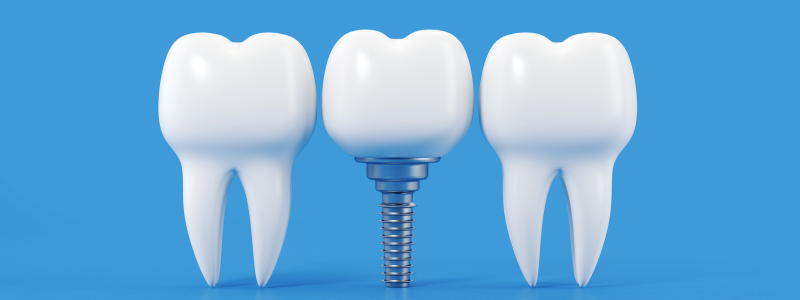
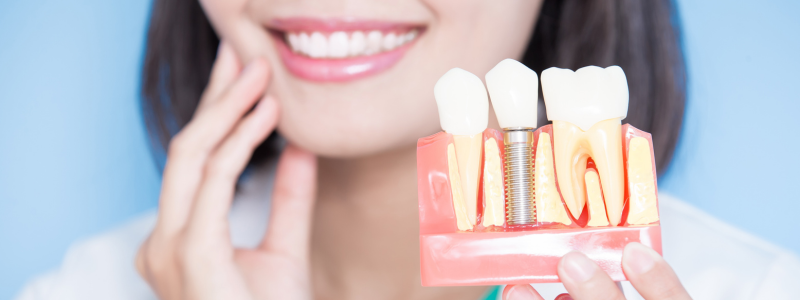
Dental implants are an alternative to dentures and appear like natural teeth that your dentist will surgically install into your jaw. With proper home maintenance and regular visits to the dentist, your implant can last for decades. Unlike partial or complete dentures, which are usually used to replace several teeth, you can get only one or two implants, making them a popular choice. They don’t require adhesive but can only be used with healthy jaws and gums. Dentists generally prefer implants because they provide a more comfortable, natural option for patients who need artificial tooth replacement — they also won’t damage surrounding teeth or gums.
| Dental Implants | Dentures |
|---|---|
| Appear as natural teeth | Partial and complete denture options |
| Option to get only one or two implants | Used to replace several teeth |
| Only useable on healthy jaws and gums | Suitable for weak or unhealthy gum tissue |
| More comfortable | Feel less natural |
| More expensive | Less expensive |
| Stay in mouth permanently | Must be removed at night |
Costs Of Dentures vs. Implants
Dentures are less expensive than implants. According to the New York Times, implants are costly despite their clear benefits over dentures, and many insurance plans won’t cover the entire cost. Nevertheless, for suitable candidates, implants offer a potentially lifelong solution that is comfortable, durable, and safe.
If you are a good candidate for implants but have minimal insurance coverage, ask your provider to use the denture allowance toward the implant instead. Also, if you use an in-network dentist, dental implants may cost less than you think.
Maintenance of Dentures vs. Implants
Whether taking care of your dentures or implants, you’ll follow a similar approach of using a soft-bristle brush to remove plaque. You’ll soak removable dentures using a nonabrasive denture cleanser. Permanent dentures or implants are taken care of in the same way you take care of your existing teeth: brushing twice daily or after each meal, flossing once daily, and using an antibacterial mouthwash.
What Lasts Longer: Dentures or Implants?
Dental implants are designed to last a lifetime, so long as you properly care for them. Dentures are also long-lasting but may need to be replaced every 10 to 20 years due to wear or bone structure changes.
Which is Less Painful: Dentures or Implants?
Dentures feel less natural and sturdy than implants, making them less comfortable. Especially for removable dentures, you may experience soreness towards the end of the day. Implants are permanently placed in your mouth and are designed to feel and look as natural as possible.
Are Permanent Dentures Cheaper Than Implants?
Both are custom-fit to your mouth, but permanent dentures typically replace a greater number of teeth than implants, causing them to be more costly. That said, it’s more cost-effective to pay for custom dentures than implants if you replace an entire set of teeth.
Bone Health and Dental Implants
Dental implants require a strong, healthy jawbone for successful placement, as they fuse with the bone in a process called osseointegration. Weak or deteriorated bone, often due to long-term tooth loss or gum disease, may require a bone graft before implants can be placed. We use advanced imaging, like 3D X-rays, to assess your jawbone health and determine if implants are suitable. If bone loss is a concern, dentures may be a better option, as they don’t rely on bone strength.
Mini Dental Implants
Mini dental implants are a smaller, less invasive alternative to traditional implants, ideal for patients with limited bone density or those replacing a single tooth. They require less recovery time and are often more affordable, though they may not last as long as standard implants (typically 10–15 years with proper care). We offer mini implants for suitable candidates, providing a natural-looking solution without extensive surgery. Like traditional implants, they’re brushed and flossed like natural teeth.
How Dentures and Implants Affect Daily Life
Dentures and implants impact daily life differently. Dentures, especially removable ones, may slip during eating or speaking, requiring adjustments and limiting hard or sticky foods. Implants, anchored securely in the jaw, allow you to eat a wider variety of foods, from apples to steak, and speak confidently without slippage. Implants feel like natural teeth, boosting self-esteem, but require healthy gums and diligent care.
Implant-Supported Dentures
Implant-supported dentures offer a hybrid solution. We use a few implants (typically 2–4) to anchor a full or partial denture, providing greater stability than traditional dentures. They don’t require adhesives, stay secure during eating and speaking, and are easier to maintain than removable dentures. However, they cost more than standard dentures but less than a full set of implants.
Long-Term Oral Health Benefits of Implants vs. Dentures
Dental implants preserve oral health by preventing bone loss, which occurs when teeth are missing. By stimulating the jawbone like natural tooth roots, implants maintain facial structure and reduce gum recession. Dentures, while effective, don’t prevent bone deterioration, which may lead to fit issues over time. Implants also protect adjacent teeth, as they don’t rely on them for support, unlike some partial dentures.