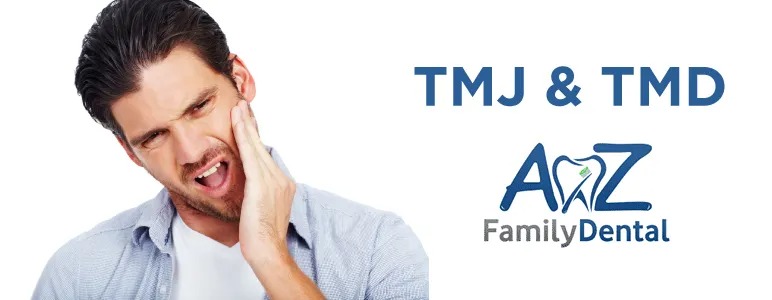
Temporomandibular joint syndrome and temporomandibular disorders can be a literal pain in the neck. These conditions, more commonly known as TMJ and TMD, are disorders of the jaw. Yet they are masters of disguise; they can manifest in many ways, and you may not necessarily have pain in your jaw.
TMD and TM symptoms can include anything from headaches to numbness in the fingers to, yes, even a pain in the neck. Because the symptoms of TMD and TMJ are so varied, many people never realize they have these disorders, and so they do not receive the proper treatment. At our dental practice serving the Phoenix area, we often see patients who have been in pain for years and never had an inkling they suffered from TMD or TMJ disorders. The good news is that once you have been diagnosed, there are a variety of treatment options, including home remedies, medicine or even surgery.
What Is TMJ? What Is TMD?
TMJ and TMD are essentially interchangeable terms for the same problem. The temporomandibular joint is the hinge in your jaw connecting the jaw to your skull. It’s what allows you to move your jaw up and down to eat and talk. Any problem with this joint is technically referred to as a temporomandibular disorder. But these problems are more commonly referred to as temporomandibular joint syndrome, or TMJ disorder. We’ll use these terms interchangeably, as people may refer to the disorder as either one. They mean the same thing.
TMJ Causes
There can be many causes of TMJ pain. Your risk of developing this disorder rises if you have a lot of stress or are extremely sensitive to pain. The mostcommon causes of TMJ and TMD include:
- Frequent clenching or grinding your teeth Also called bruxism, it puts pressure on the joint, sparking the pain.
- Arthritis of the temporomandibular joint This results in less range of motion for your jaw.
- Other inflammatory disorders This can lead to pain in the jaw since the joints often become inflamed.
- Anxiety When you’re tense all the time, you tighten your jaw muscles and clench your teeth.
- Chewing gum all the time Your jaw may tire out.
- Bad posture When you do not stand up straight or hunch over a computer, it strains the neck and jaw.
- Bad teeth These result in uneven chewing, putting stress on the jaw line.
- Previous jaw fracture Even after the bone has healed, you are at greater risk of developing TMJ.
- Jaw surgery After recovery, your jaw may lose some mobility, prompting the development of TMD.
- Lockjaw, also called trismus If you cannot fully open your jaw, you may also develop TMJ.
TMJ and TMD can also be caused by a combination of these factors. The condition is not uncommon, either. More than 10 million Americans suffer from TMJ pain, but many cases also go undiagnosed because this disorder causes so many wide and varied symptoms. It can be difficult to connect them to TMD.

One thing that doesn’t cause TMD? Braces. Though this is a common rumor, TMJ experts say there has been no proof linking this orthodontic device to TMD.
TMJ Symptoms
There are a vast number of symptoms of TMD. The degree of your TMJ pain may vary, too. Some patients in our Peoria-area dental practice report sharp, unbearable stabs of pain. For others it’s a dull ache that doesn’t go away. Here’s an in-depth look at the symptoms of TMJ and how they may be impacting you:
 Migraines and headaches. The TMJ migraines and headaches our patients experience differ from allergy or sinus-induced headaches. They return frequently, are not always responsive to medicine, and may be accompanied by tenderness or pain in the jaw.
 Facial pain. Facial pain from TMJ might include:
- Swelling on either side of the face
- Tired cheeks or jaws
- Popping of the jaw
 Ear pain. TMJ ear symptoms are one of the most common complaints for suffers. Often, patients complain about ringing in the ears or buzzing that doesn’t go away. This is caused when a misalignment of the jaw results in stress that radiates up the jaw line and irritates the ear canal. Patients often report dizziness or numbness along with ear pain, which helps point to TMJ.
 Congestion. Got a stuffy nose that just won’t go away? It could be a TMD symptom. The ears, nose and throat are so closely connected that aggravation of the jaw line can result in excessive mucus production. TMJ sufferers often find a decongestant has little impact on their frequent congestion.
 Jaw pain. No surprise here: When the jaw is out of whack, it causes a lot of pain in the area. Frequent complaints include:
- Grating of the jaw
- Clicking of the jaw
- The jaw getting stuck when it’s opened or closed
While the degree of pain may vary, all are extremely annoying and can lower the overall quality of life.
 Tooth pain. Yes, individual teeth can experience pain when the real cause is actually TMD. When the jaw is aligned and working properly, pressure will be spread out among the teeth when a person chews. But when the top and bottom teeth are not fitting together, teeth may come under too much pressure.
 Neck and back pain. Pain caused by TMJ can radiate down your neck and back. This can be exacerbated by poor posture, which is a cause of TMD to begin with. When you thrust your head forward while sitting at your desk, for example, you strain your jaw and force it to “rest” in the open instead of the closed position. This puts it under stress, and your neck and back pay the price for that undue pressure.
 Numbness of the arms, hands and fingers. Numbness of the extremities can be a symptom of many disorders, including TMJ. When muscle spasms caused by TMJ occur in your face, they can pinch other nerves in the body, leading to numbness in your arms, hands or fingers. Tingling may also occur in these areas and, in extreme cases, cold or bluing of these extremities can develop. Rarely, TMJ will cause numbness in the face. Numbness occurs when the temporomandibular puts pressure on the nearby trigeminal nerve, which carries signals to your forehead and face. When this happens, it may cut off sensory input to these areas, resulting in loss of feeling.
 Shoulder pain. Your jaw is not connected directly to your shoulder, so you may wonder how TMJ can cause shoulder pain. When you carry stress in your jaw, it can radiate down your body. For example, if your jaw is becoming fatigued because of poor posture that keeps your mouth open all the time, your shoulders will tense up to compensate for the exhaustion. This leads to shoulder pain.
 Back pain. Like shoulder pain, back pain can also be linked to TMD because of poor posture. When your spine gets out of alignment, TMJ can develop, and your inability to stand up straight will result in pain in the upper back. Untreated, this TMJ pain will only get worse.
How Do You Diagnose TMJ?
Unlike a pregnancy test that comes back negative or positive, there’s no automatic TMD testing. It’s more like detective work. Your dentist can make an informed decision based on your symptoms and how long they have been occurring. Sometimes another medical professional, such as a physical therapist or a family doctor, can also recognize the symptoms of TMJ along with certain risk factors. In those cases, they may recommend you make an appointment with a family dentist who has experience treating TMJ to see if you have it. At a TMJ exam, the dentist will:
- Take a full oral medical history
- Catalog all TMJ symptoms
- Assess jaw muscle and joint functionality
- Look at your teeth and your bite pattern
- Order magnetic resonance imaging (MRI) to determine if the disc in your joint moves correctly
Once these steps have been taken, the dentist will have enough evidence to diagnose TMD.
TMJ Treatment
After a TMJ diagnosis has been given, the first concern is offering TMJ pain relief. It’s a very uncomfortable disorder, and many people have several symptoms, not just one. Often, patients begin with home remedies. If those don’t work, then they move on to other treatments. Those can range from injections to surgery. Let’s take a look at each one of these common TMJ relief options:
- TMJ home treatments. There are many home remedies you can use to help ease your TMJ symptoms. Of course, a few should be obvious. We may tell our Glendale-area patients to stop chewing gum and establish correct posture for some immediate relief. Other proven home remedies include:
- Putting ice packs on the jaw
- Using relaxation techniques, such as meditation, to decrease tension in the jaw
- Stretching the jaw gently
- Switching to soft foods
- Applying moist heat to the jaw line for 30 minutes two to three times each day
Sometimes home remedies do not provide enough TMJ pain relief. If that’s the case, it’s time to try other options.
- TMJ injections. One way to relieve the pain and tension associated with TMJ is through Botox injections. Though Botox is known mostly for helping people look younger by reducing wrinkles, it also relieves the jaw tension associated with TMD. However, the federal Food and Drug Administration has not approved this as a TMD treatment.
- Physical therapy for TMJ. A physical therapist can give you TMJ exercises that will strengthen your jaw and help you regain the full motion of the joint. He or she can also:
- Educate you about proper posture
- Use pain treatments such as electrical stimulus
- Break down scar tissue in the jaw using massage
- TMJ medicine. Muscle relaxers, anti-depressants and pain relievers can be prescribed by your TMJ specialist to relieve jaw pain.
- Dental improvements. Since TMJ can be caused by missing teeth or a misaligned jaw, getting dental treatment can help. Bite problems can be corrected by using:
- Bridges
- Crowns
- Braces
- Retainers
- TMJ mouth guard. If your TMJ is being caused or exacerbated by bruxism, or grinding of the teeth, your dentist may suggest having a mouth guard made. You can wear the guard at night to protect your teeth from grinding and gently guide them into correct positioning.
- TMJ splint. A splint can also be worn to correct problems from TMD. A splint is very similar to a mouth guard, but it’s worn all day instead of only at night.
- Surgery for TMD. Surgery is usually the last resort for any ailment, and that’s no different for TMD. Once other options have been exhausted, your dentist may refer you to an oral surgeon to correct an underlying problem that’s causing TMJ. There are three forms of TMJ surgery:
- Arthrocentesis : This is the least-invasive surgery and can be done with general anesthesia. The doctor uses a needle to get a locked jaw unstuck.
- Arthroscopy : Using an arthroscope inserted through a slit near your ear, the surgeon can realign the disc in your joint or get rid of built-up scar tissue.
- Open-joint surgery : The most invasive procedure, this involves a full opening of the jaw, which could lead to removal of tumors or bone chips. It can take a long time to heal from this surgery, and in rare cases, it may result in nerve damage.
Before you get surgery of any type, you should weigh all your options and speak with your dentist about how surgery would impact your overall dental health.
Can TMJ Be Prevented?
As the symptoms suggest, TMD can be a very painful condition. We see many patients from the Phoenix area who worry about relapsing or experiencing TMD, and they ask if there are any preventative measures that can be taken against the disorder.
| Five tips to lessen your chance of developing TMJ |
|---|
| Use a headset instead of holding the telephone between your shoulder and ear. |
| Practice good posture, especially at work, where it’s easy to forget about keeping your shoulders back while you hunch over a computer. |
| Don’t open your jaw too widely. |
| If you smoke, quit. |
| See your dentist regularly for good oral hygiene, which lessens the chance of getting a jaw disorder. |
Do I Have TMJ Disorder?
If, after reading through this guide, you think you may be suffering from TMJ, you should schedule an immediate trip to the dentist to be evaluated and diagnosed. The sooner you get an appointment, the sooner you can begin treating your TMD symptoms. AZ Family Dental has lots of experience treating patients with TMJ in the Glendale, Peoria and greater Phoenix area. Contact us today to set up an appointment.